New York, 1966. Mentre San Francisco si prepara all'estate dell'amore — fiori nei capelli, pace e luce, il sogno che sarebbe durato dodici mesi prima di frantumarsi su se stesso — al 231 di East 47th Street succede qualcosa di completamente diverso. Andy Warhol ha affittato un magazzino industriale e lo ha rivestito di carta stagnola argentata. Lo chiama The Factory: non per ironia, ma perché è davvero un luogo di produzione, un posto in cui si fabbricano immagini, serigrafie, film sperimentali, performance e, alla fine, musica.
New York, 1966. While San Francisco prepares for the summer of love — flowers in hair, peace and light, a dream that would last twelve months before shattering — at 231 East 47th Street something completely different is happening. Andy Warhol has rented an industrial warehouse and lined it with silver foil. He calls it The Factory: not for irony, but because it really is a place of production, somewhere images, silkscreens, experimental films, performances and, eventually, music are made.
Lou Reed ha ventiquattro anni e scrive canzoni su droghe, sadomasochismo, transessualità e morte non per provocare, ma perché sono le cose che vede sotto gli occhi ogni giorno. John Cale viene da una formazione di musica classica d'avanguardia con La Monte Young e porta nel gruppo un senso del timbro e del rumore che il rock non ha mai incontrato. Sterling Morrison e Maureen Tucker completano una formazione che suona come nessun'altra: feroce e delicata allo stesso tempo, colta e volutamente rozza, capace di passare da una ninna nanna in sottotono a un muro di feedback nel giro di tre tracce.
Lou Reed is twenty-four and writes songs about drugs, sadomasochism, transsexuality and death not to provoke, but because these are the things in front of him every day. John Cale brings avant-garde classical training with La Monte Young and a sense of timbre and noise the rock form has never encountered. Sterling Morrison and Maureen Tucker complete a lineup that sounds like nothing else: ferocious and delicate simultaneously, learned and deliberately raw, able to move from a hushed lullaby to a wall of feedback across three tracks.
La banana di WarholWarhol's banana
Warhol non si limitò a produrre il disco. Lo firmò come se fosse una sua opera, con il suo nome in copertina più grande di quello della band. Questa mossa — che la band accettò a metà con entusiasmo e a metà con rassegnazione — fu sia una fortuna sia un problema. Una fortuna perché portò attenzione su un disco che altrimenti non avrebbe avuto nessuna distribuzione seria. Un problema perché per anni oscurò la natura di quello che Reed, Cale e gli altri stavano costruendo autonomamente.
Warhol didn't just produce the record. He signed it as if it were his own work, with his name on the cover larger than the band's. This move — accepted by the band half with enthusiasm and half with resignation — was both a fortune and a problem. A fortune because it brought attention to a record that would otherwise have had no serious distribution. A problem because for years it obscured the nature of what Reed, Cale and the others were building on their own terms.
Peel slowly and see. L'oggetto quotidiano trasformato in arte: il frutto come metafora dell'atto di rivelare qualcosa sotto la superficie.
Peel slowly and see. The everyday object transformed into art: the fruit as a metaphor for the act of revealing something beneath the surface.
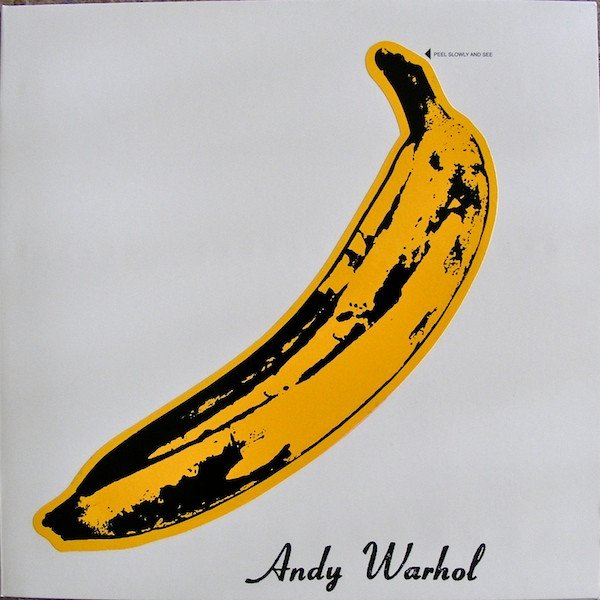
La copertina era una banana gialla su fondo bianco. Semplice, quasi infantile. Le prime copie avevano un'etichetta adesiva con la scritta «peel slowly and see»: sbucciandola, si scopriva una banana rosa. Un'idea di Warhol — l'oggetto quotidiano trasformato in arte, il frutto come metafora dell'atto di rivelare qualcosa sotto la superficie. Le prime presse con la banana pelabile intatta sono oggi tra i dischi più ricercati al mondo: copie Near Mint raggiungono i tremila euro su Discogs, quando si trovano.
The cover was a yellow banana on white. Simple, almost childlike. Early copies had a peel-off sticker reading «peel slowly and see»: underneath was a pink banana. A Warhol idea — the everyday object elevated by context, the fruit as metaphor for revelation. First pressings with the peelable sticker intact are among the most sought-after records in the world: Near Mint copies clear three thousand euros on Discogs when they appear.
Cosa c'era dentro il discoWhat was inside the record
Il disco si apre con Sunday Morning — ed è questa la prima sorpresa. Celesta, archi morbidi, la voce di Reed quasi sussurrata: un mattino dopo qualcosa che non si desidera ricordare. La dolcezza è reale, non ironica, ma porta con sé una malinconia diffusa come nebbia. I'm Waiting for the Man è il rovescio immediato: tre accordi di piano martellati con l'urgenza di chi sta aspettando davvero qualcosa, il testo un resoconto quasi giornalistico di un acquisto di eroina a Harlem.
The record opens with Sunday Morning — and this is the first surprise. Celesta, soft strings, Reed's voice almost whispered: a morning after something you don't want to remember. The sweetness is real, not ironic, but carries a melancholy diffuse as fog. I'm Waiting for the Man is the immediate reverse: three piano chords hammered with the urgency of someone genuinely waiting for something, the lyric a near-journalistic account of a heroin purchase in Harlem.
Heroin è il centro di gravità del disco: otto minuti in cui il ritmo accelera e decelera come un respiro che cambia, la viola di Cale che porta il rumore fino alla soglia della tolleranza, Reed che canta senza giudizio di nessun tipo su cosa significhi perdersi in una sostanza. Non è un'ode alla droga — è qualcosa di più preciso e più scomodo: una descrizione.
Heroin is the record's centre of gravity: eight minutes in which the tempo accelerates and decelerates like changing breathing, Cale's viola pushing the noise to the threshold of tolerance, Reed singing without any judgment about what it means to lose yourself in a substance. It's not an ode to the drug — it's something more precise and more uncomfortable: a description.
Venus in Furs prende Sacher-Masoch e lo trasforma in un drone ipnotico di quattro minuti che non sarebbe suonato fuori posto in un film di Bergman. All Tomorrow's Parties affida la voce a Nico — tedesca, bellissima, gelida come marmo — sopra un piano che suona come una campana funebre in lento deterioramento.
Venus in Furs takes Sacher-Masoch and turns it into a hypnotic four-minute drone that wouldn't sound out of place in a Bergman film. All Tomorrow's Parties gives the vocal to Nico — German, beautiful, cold as marble — over a piano that sounds like a funeral bell in slow deterioration.
Tutti quelli che hanno comprato uno dei cinquecento dischi hanno poi fondato una band. Everyone who bought one of those five hundred records went on to form a band. Brian Eno · 1982
Perché non lo comprò nessunoWhy nobody bought it
The Velvet Underground & Nico uscì il 12 marzo 1967 per Verve Records, etichetta sussidiaria di MGM. La MGM era nervosa: i testi di Reed parlavano esplicitamente di droghe e di sesso in modi che nessuna radio voleva trasmettere. La promozione fu minima. Il disco entrò ed uscì dalle classifiche nel giro di settimane, senza lasciare traccia commerciale.
The Velvet Underground & Nico came out on March 12, 1967 on Verve Records, an MGM subsidiary. MGM was nervous: Reed's lyrics spoke explicitly of drugs and sex in ways no radio station wanted to broadcast. Promotion was minimal. The record entered and exited the charts within weeks, leaving no commercial trace.
Mentre Sgt. Pepper's Lonely Hearts Club Band dominava le classifiche mondiali con la sua promessa di un pop colto e allegro, il primo album dei Velvet Underground languiva in un magazzino. La band sarebbe rimasta in vita ancora qualche anno, perdendo prima Nico, poi Cale, poi Reed, fino a sciogliersi nel 1973 senza mai aver avuto un disco di successo commerciale.
While Sgt. Pepper's dominated the global charts with its promise of learned, cheerful pop, the Velvet Underground's first album languished in a warehouse. The band would survive a few more years, losing first Nico, then Cale, then Reed, before dissolving in 1973 without ever having had a commercially successful record.
Il paradosso è che proprio l'insuccesso commerciale ha contribuito alla leggenda. Chi comprò una delle poche copie nel 1967 era già, per definizione, qualcuno fuori dal mainstream — un artista, un musicista, qualcuno in cerca di qualcosa che il pop normale non forniva. Quelle poche centinaia di persone diventarono moltiplicatori.
The paradox is that the commercial failure itself contributed to the legend. Anyone who bought one of the few copies in 1967 was already, by definition, someone outside the mainstream — an artist, a musician, someone looking for something ordinary pop didn't provide. Those few hundred people became multipliers.
Le band che non sarebbero esistiteThe bands that would not have existed
L'influenza dei Velvet Underground è uno di quei fenomeni che diventano più evidenti man mano che si allontana dal centro. Il punk rock del 1976 — i Ramones, i Sex Pistols, i Wire — prende direttamente dalla loro idea di rock ridotto all'osso, privo di virtuosismo decorativo, fondato sul ritmo e sulla ripetizione piuttosto che sull'elaborazione.
The influence of the Velvet Underground is one of those phenomena that become more visible the further you get from the centre. The punk rock of 1976 — the Ramones, the Sex Pistols, Wire — draws directly from their idea of rock stripped bare, without decorative virtuosity, built on rhythm and repetition rather than elaboration.
David Bowie studia la loro estetica e ne porta elementi nel glam rock. Television, Patti Smith, Talking Heads escono tutti da un milieu newyorkese in cui i Velvet sono riferimento ineludibile. Il post-punk degli anni Ottanta — Joy Division, Bauhaus, The Cure — prende la loro oscurità e la amplifica. Sonic Youth e Pixies costruiscono interi stili sulle tecniche di chitarra che Reed aveva usato per primo.
David Bowie studies their aesthetic and carries elements of it into glam rock. Television, Patti Smith, Talking Heads all emerge from a New York milieu in which the Velvets are an unavoidable reference. The post-punk of the eighties — Joy Division, Bauhaus, The Cure — takes their darkness and amplifies it. Sonic Youth and the Pixies build entire styles on the guitar techniques Reed had used first.
Quale pressing cercareWhich pressing to find
Il pressing originale Verve (V/V6-5008, 1967, etichetta MGM verde) è la copia da collezionismo per eccellenza. Le copie con la banana pelabile intatta sono un Sacro Graal: aspettarsi prezzi tra i 1.600 e i 3.000 euro a seconda delle condizioni e della rarità dello stamper. Le copie con la banana già pelata si trovano tra i 60 e i 200 euro — ancora un acquisto significativo, ma accessibile.
The original Verve pressing (V/V6-5008, 1967, MGM green label) is the collector's copy par excellence. Copies with the peelable banana intact are a holy grail: expect prices between 1,600 and 3,000 euros depending on condition and stamper rarity. Copies with the banana already peeled run between 60 and 200 euros — still a significant purchase, but accessible.
La qualità audio dell'originale è buona, non eccezionale: la produzione di Tom Wilson era spartana per budget e per scelta, e i limiti tecnici sono parte del suono. Le ristampe MGM degli anni Settanta suonano sostanzialmente equivalenti all'originale.
The original's audio quality is good, not exceptional: Tom Wilson's production was spare by both budget and choice, and the technical limitations are part of the sound. MGM reissues of the seventies sound substantially equivalent to the original.
La ristampa Sundazed su 180g del 2002 è il riferimento moderno più convincente: mastering curato, buona separazione stereo, pressing silenzioso — la scelta consigliata per l'ascolto quotidiano. La UHQR di Analogue Productions spinge ulteriormente sulla qualità audiofila, ma il prezzo elevato la rende una scelta per collezionisti seri piuttosto che per ascoltatori.
The 2002 Sundazed 180g reissue is the most convincing modern reference: careful mastering, good stereo separation, quiet pressing — the recommended choice for everyday listening. The Analogue Productions UHQR pushes further into audiophile territory, but the high price makes it a choice for serious collectors rather than listeners.
C'è un paradosso al cuore della storia del Velvet Underground. Il disco che non vendette nulla è diventato, nel tempo, uno dei pochi su cui studiare davvero il rock. There is a paradox at the heart of the Velvet Underground story. The record that sold nothing has become, over time, one of the few on which to genuinely study rock. Sergio S.